Galleries
Shining Light on Truth: Black Lives at Yale & in New Haven
Installed at the Schwarzman Center, “Shining Light on Truth: Black Lives at Yale & in New Haven,” illuminates ongoing research that recovers the essential role of Black people throughout Yale and New Haven history. The exhibition puts back at the center of local storytelling people who have always been central to local history. It celebrates Black community building, resistance, and resilience on campus and in New Haven.
The show includes nearly one hundred images of Yale’s earliest Black students from the 1800s and early 1900s, many of whom had deep New Haven connections. The Schwarzman exhibition features compelling reproductions of photographs of New Haveners who were custodians of Yale. The Luke, Grimes, Creed, Park, and Bassett families, among the many people key to founding and sustaining Yale, and who are heralded in the show.
“Shining Light on Truth: Black Lives at Yale & in New Haven” showcases the proposal, made and thwarted in 1831, to build a Black college in New Haven. It also highlights the successful efforts of Black students in the 1960s to establish the Afro-American Cultural Center and Afro-American Studies at Yale.
This exhibition brings forth knowledge kept alive in archives and memory for many centuries—even when the dominant culture chose to ignore, bury, or forget. It extends the work of the Yale and Slavery Research Project and follows from the exhibition, “Shining Light on Truth: New Haven, Yale and Slavery,” at the New Haven Museum from February 16, 2024 – March 1, 2025.
The exhibition team includes David Jon Walker ’23 MFA, lead designer, and Michael Morand ’87 ’93 DIV, lead curator, with Timeica Bethel ’11, Robert Laird Brown, Jennifer Coggins, Mohamed Diallo ’26, Regina Mason, Hope McGrath, Carlynne Robinson, and Charles Warner, Jr.
Shining Light on Truth brings the receipts. Without knowing stories like those presented here, we cannot fully understand who we are or where we are as a university and a community. As you move through, reflect on what you didn't know, what you need to know, and what should be done.
You are here as a participant in the future. Work remains to remember, repair, and renew.

Shining Light on Truth: Black Lives at Yale & in New Haven at Yale Schwarzman Center, 2025. Photo: Jessica Smolinski
Early Black Students and Graduates
This gallery features images of some of the earliest Black students at Yale, from James W.C. Pennington in the 1830s to Shirley Graham Du Bois in the late 1930s. It is a representative selection of the more than 300 graduates in the first century of Black presence in Yale classrooms.
You can learn more through the digital humanities project, Shining Light on Truth: Early Black Students at Yale. The website provides a collection of biographical sketches and images of these Black students and alumni. It reflects an ongoing effort to identify and recognize the many Black pioneers who were part of the Yale community in these early years–not only the "firsts."
Early Black Staff
Buildings at Yale and other institutions typically bear names and markings of leaders and major donors, the people most often remembered as founders and sustainers. There are, however, many others, too often unremarked, who are responsible for building and maintaining property.
Enslaved and free Black people were early builders of and staff at Yale. Down through more than three centuries, Black workers have been essential to the work of the university. They have, literally and metaphorically, been custodians of Yale.
The photographs collected here were taken of Yale custodians and carpenters in the late nineteenth century and early twentieth century. The existence of these professional photographs reflects that status and stature of these in campus life.
Presidents' Gallery on Floor 2


The Afro-American Cultural Center at Yale
Afro-America–a home away from home for the growing numbers of of Black Yale students, and a focus for political, cultural, and social activities–opened at 1195 Chapel Street in fall 1969. It is the first Black cultural center of the Ivy League.
From its inception, the Afro-American Cultural Center, as it was later renamed, has represented the vital and vibrant presence of Black students within Yale's walls. At the same time, the location on the edge of Yale's campus provided access to the New Haven community. In 1970, the Center moved to its present location at 211 Park Street.
1831 College
In the spring of 1831, a national coalition of Black leaders and white allies advanced a bold idea – the creation of a college for Black men. They proposed building it near Yale, as "the literary and scientific character of New Haven renders it a very desirable place for the location of the college." This community was seen as a "friendly, pious, generous, and humane" place where "boarding is cheap and provisions are good." A group appointed by the First Annual Convention of the People of Color in Philadelphia began raising money and making plans, gaining support from a network of churches and abolitionists.
On September 10, 1831, the city's white freemen spoke with a near unanimous voice: seven hundred opposed the college and only four supported it. Instead of becoming home to the nation's first Black college in 1831, New Haven was a city where dreams of Black education faced defeat and disappointment.
To learn more about the effort to establish the nation's first Black college in New Haven in 1831, watch What Could Have Been, a short documentary film from the Beinecke Library at Yale.
The Well Gallery on the Lower Level


Shining Light on Truth: Black Lives at Yale & in New Haven at Yale Schwarzman Center, 2025. Photo: Jessica Smolinski
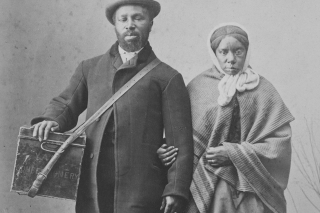
Theodore and Mary Ferris, c. 1861. Source: Student Life at Yale Photographs (RU 736), Yale University Library.